Cathy Pagano’s Take, FM July 2018

from CathyPagano.com

“The cosmic waves of change keep rolling in…

“Don’t forget to go out and look at the Full Moon, even if you can’t see the eclipse. 

“The sight of the Full Moon and brilliant Mars shining nearby will imprint on your psyche in a magical way.

“Eclipses are magical moments where something slips through an energy portal to both destroy and create. It’s a path opener.

“Eclipses are known to bring things to a head; something is released, especially at a total lunar eclipse. It’s time to bring things sleeping into the light.

“The energies during the past few months have been intense and chaotic, and it feels like things are getting more intense, very much like the stage in labor called transition – the contractions keep coming without stop. It’s an intense time, but it presages birth…

(YES, SINCE APRIL – in my experience, anyway. Really as far back as February for me.)

“It’s during this most intense stage of labor that mothers have to try to stay focused on our task – to birth new life…

“So during this powerful Blood Full Moon lunar eclipse, when the light of the Moon is veiled, we have to stay focused, to see and understand what lives deep within us, those parts of ourselves we’ve locked away from our awareness that need to be seen and acknowledged.

“These parts might be gifts we developed in other lifetimes, old behavior patterns shaped by beliefs that no longer serve us, or lies we’ve told ourselves about who and what we are…

(Yes, and yes.)

“When outer planets are involved in an eclipse pattern, it signals a change in the collective energies as well as in our personal energies.

“…It’s time to figure things out – to see the root cause of our trauma and heal it through the trine to Chiron in Aries – through a new understanding of who we really are.

“We can ground in the meaning and purpose of our life experience when we see ourselves clearly.

“The healing is for masculine energy in men, woman and the world

“The Divine Feminine has been awake in the world since the 70s.

“It’s time for the divine Masculine to be birthed anew

“Warrior, father, lover and magician: these are the archetypal energies that need to be embraced and developed as the New Masculine.

“Will men rise to the occasion? Some of you have. Hopefully, you will help others who are ready.

“This means women have to do things differently as well, since we also have patterns of how we use our masculine energies that have been shaped by patriarchy.

“It’s time for women to find our own way of doing things. And many of us already have.

“Deep change is upon us and we have a chance to work consciously with it…

“These cosmic alignments focus on what questions we need to be asking ourselves.

“How does masculine spirit want to be renewed and incarnated now?

“…How do we deal with Mars’ shadow of aggression, anger and competition? What is bravery?

“How do we change our way of doing things? How can we shape something different by how we act in the world?

“Are we living our dharma? How are we contributing our knowledge and wisdom to the world?

“…Mars retrograde with South Node in Aquarius will find us walking away from collective expectations of what we should do and how to do it. 

“Just as Aquarius rules the round table of collaboration, it also rules mob mentality.

“South Node in Aquarius demands that we look at how we betray our beliefs when we don’t have the integrity to act on them.

“When it comes to dealing with Mars – the masculine spirit, left brain rationality and men – how have we been betrayed by them? 

“…With the collective nature of Mars retrograde on the South Node in Aquarius at this lunar eclipse, it’s time to recognize that our world’s fate is in our hands.

“When we engage in community on whatever level, we are participating in our world and bringing our unique gifts to the collective.

“Look at what you’ve been hiding from and bring it into the light of day where you can create something new out of it.

“With 6 of our 10 planets in fixed signs during this eclipse, there are possibilities of big personal breakthroughs on issues that have been stuck for a while.

“…We’re all being tested. Trust your inner spirit. Don’t fear the changes. We don’t have to go through anything alone. Where’s your tribe?

“Don’t be afraid to ask for help… we don’t have to go through things alone now. That’s a new way to solve old problems – help each other.”

© Copyright 2018 ~CATHY PAGANO All Rights Reserved
 

The Book of Baba Yaga

Baba Yaga is one of my favorite witches!

reprinting this from Patheos:

JUNE 15, 2018 BY PAGAN VOICES

About 4 years ago, I took a break from being a man. Even though I’ve always felt a strong affinity for the societally defined trappings of masculinity, the labels “man” and “male” suddenly felt like clothes that no longer fit. I experienced a strong need to add what our culture deems “feminine” elements to my everyday presentation—makeup, nail polish, bright and colorful clothes, etc. Yet I definitely didn’t feel like a woman either. When I heard the term “genderqueer,” I strongly identified with it.

Around the same time, an old friend texted me an ad for “Baba Beer.” “Baba” for us referred to an Alanis Morissette song. “Look!” he wrote jokingly, “Alanis has her own beer!” Yet as I read his message, I wasn’t thinking about Alanis. I was thinking about Baba Yaga.

baby yaga 1

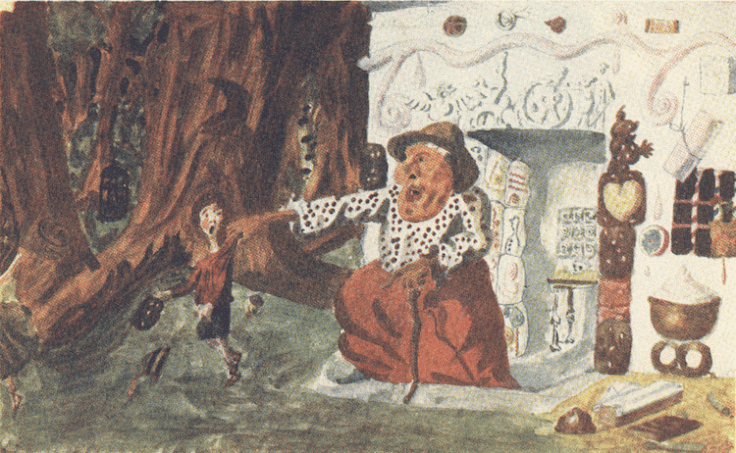
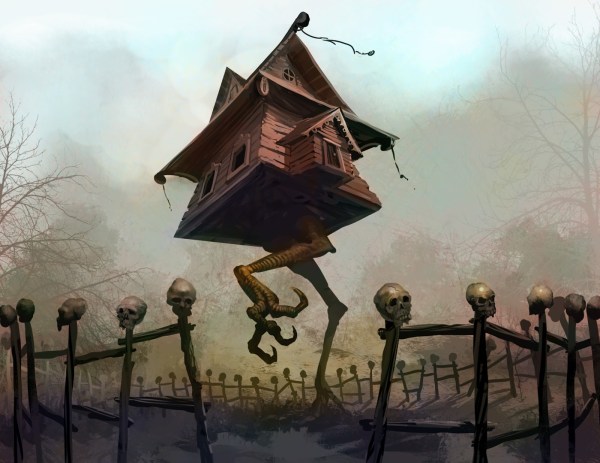
Baba Yaga is a witch/earth goddess from Russian folklore. She lives deep in the forest in a house on chicken legs. Rather than the more traditional broomstick, she flies in a mortar, using the accompanying pestle to steer. She’s a dangerous and wonderful figure who tests the wit and mettle of anyone who approaches her hut seeking help. She may grant you the tools necessary to succeed in your quest, or she may eat you.

I have no idea why I thought of Baba Yaga. I wasn’t a Pagan yet. I loved myths and fairy tales, but I was only vaguely aware of her story. Still, after getting that text, her name stayed with me. I had been looking for a new focus for my next poetry book, and the phrase “The Book of Baba Yaga” kept appearing in my head.

So I read the folktales associated with her and began writing poems. She proved to be an excellent metaphor. Versed in arcane knowledge yet deeply rooted in the earth, vicious yet oddly maternal, I explored the various facets of her character. I didn’t really think of her as anything other than a mythological figure, a darker version of the Wise Woman archetype. It wouldn’t take long for me to realize that Baba Yaga is quite real, and she was, as one friend put it, stirring me in her mortar.

Not long after I started writing the book, I began to go through a lot of personal troubles. For a variety of reasons, my until then manageable anxiety and depression became unmanageable. I started having panic attacks which would cause me to hyperventilate and wail. Literally, I would wail. It reminded me of those ponderous Biblical descriptions of hell as a place where there is “much wailing and gnashing of teeth.” Later I would realize in therapy that I was, almost two decades after the fact, grieving years of childhood abuse.

Baba_Yaga_by_Koka_1916
Public Domain image via WikiMedia.

The force of my reaction frightened me as much as the attacks themselves. It made me feel irrevocably broken and, for some reason, completely unlovable. Desperate for relief, I started meditating.

In meditation, I became aware of the energies that surround us. I realized I could subtly manipulate these energies in playful ways—e.g., bouncing a luminescent ball between my hands. It brought me back to high school and my few tentative attempts at practicing witchcraft. If what I was doing in meditation was a form of magick, maybe it could help me heal myself.

Not surprisingly, all these new developments began to appear in my writing. Mental health, gender identity, magick…as I continued to work on “The Book of Baba Yaga,” I realized that for me she stood at the nexus of these things. As a monstrous witch/benevolent wise woman who dwells in the heart of the dark forest, she’s an ideal emissary of the subconscious mind where pain coexists with potential. Furthermore, her strong association with the divine feminine can compel a man to explore his own relationship with femininity.

But how does one define femininity? We live in an era where many are rightly questioning what it means to be a woman or a man, or if these categories even truly exist. In keeping with this perspective, I did not experience the divine feminine as qualities stereotypically associated with women (empathy, intuition, tenderness, etc.). Instead, being a man under the magickal influence of a strong female deity taught me how to embrace in-betweenness. I began to better understand my motives for wearing make-up and nail polish. Although these are not inherently “woman things”—and Baba Yaga herself is certainly not the make-up and nail polish type—they are common symbols of femininity in the 21st century West. Not only that, but they were accoutrements that appealed to me personally. And by adopting them while simultaneously retaining my shaved head and beard, I was working through and proudly making visible to others my complex and contradictory nature as a human being. Baba Yaga was shaking me out of my worldview and refusing to replace my old certainties with new ones.

Existing between genders or transitioning to a different one is an important goal for some people. For me, existing between genders was a way to learn how to embrace ambiguity more generally and exist between my past and future selves.

baba yaga 2
She doesn’t play well for the cameras, Public Domain Image via WikiMedia.

Integrating these lessons and writing a book about it empowered me. It was this sense of power—along with therapy, medication, and the love of a good husband—that helped me learn how to manage my mental health. I still deal with anxiety and depression, but I no longer have the panic attacks. Things that used to trigger me in the day-to-day have also lost much of their bite. I feel more centered and more myself than ever before.

I think now about Baba Yaga’s destructive aspect—that of the witch who swallows you whole. I’ve come to believe that the emotional challenges I went through were a manifestation of this. My wounded inner child needed to be devoured by the goddess-witch so I could be reborn as a truer version of myself.

Interestingly, I’ve stopped wearing makeup and no longer identify as genderqueer. I suspect it’s because Baba Yaga has withdrawn now that I’ve found my path. Having internalized her lessons, I no longer feel drawn to the tools—for now. I’ve circled back to identifying as a cisgender man with the understanding that gender remains fluid and mercurial.

One final note—“The Book of Baba Yaga” has been retitled Divining Bones, and will be published by Sundress Publications in early 2019. You can probably guess who it will be dedicated to.

via The Book of Baba Yaga

A letter to my rock-bottom

“Rock bottom became a solid foundation on which I rebuilt my life.”
– J.K. Rowling

(taken from OJ’s Prides’ “We Strive to Thrive in Life” post

kuthucomma's avatarkuthu comma

Dear rock-bottom,

You have been taunting me for the past few years. You are using all your dirty tricks upon me. You hit me in my face and you pull apart my life like no one ever did. You just wanted to broke me financially,mentally, spiritually and socially. You hit me hard in all of my weakest places. You gripped your vices on me , you tried to take away my happiness, my dreams and my hopes.

I know why you are so merciless to everyone. Because people curse you, hate you and they wanted to drive you away. So you taunt them more, you just want to break everyone ,hit them hard.

Somehow , you broke me technically,but not completely. You know why?

Because I choose to embrace you,no matter how vicious you are I still like you🤗. And I accepted my rock bottom as the blank slate where…

View original post 221 more words

Seven Reasons Why . . .

. . . We Need Mister Rogers More Than Ever

JUNE 6, 2018 BY PAUL ASAY, of Watching God

Photo: Fred Rogers on the set of his show Mr. Rogers Neighborhood from the film, WON’T YOU BE MY NEIGHBOR?, a Focus Features release. Credit: Jim Judkis

trolley.jpg

On Feb. 2, 1968—Groundhog Day—Simon & Garfunkel recorded the final version of their classic song “Mrs. Robinson” for their album Bookends. It includes one of the most poignant lines in all of pop music:

Where have you gone, Joe DiMaggio? Our nation turns its lonely eyes to you.

“I thought of him as an American hero and that genuine heroes were in short supply,” Paul Simon later told The New York Times. And indeed, in early 1968, they were. The country was mired in the Vietnam War. Protests raged at home. The country had never felt so divided, so angry. After the heroics of World War II and the unbridled American self-confidence of the 1950s, the United States must’ve felt like a stick bent to its breaking point, ready to splinter.

The country needed a hero.

On Feb. 19, 1968, just 17 days after Simon & Garfunkel put Mrs. Robinson in Bookends, it got one.

Most folks didn’t know it yet, of course. Mister Rogers’ Neighborhood, featuring a rather un-telegenic, soft-spoken minister as its host, director, singer, writer and puppeteer, was meant for kids too young to tie their shoes, much less write think-pieces for The New Yorker. But as Focus Features’ new, wonderful documentary Won’t You Be My Neighbor (out in theaters beginning this weekend) illustrates, he was a good hero for those turbulent times. And, I think, the sort of hero we need more than ever.

Fred Rogers wasn’t a television novice when he launched Mister Rogers’ Neighborhood on NET (the forerunner to PBS) in 1968. He’d worked on a show called The Children’s Corner for Pittsburgh’s WQED years before, introducing Daniel Tiger when (according to the movie) one of the live show’s ancient film clips broke.

But if Daniel’s introduction to the world of television was a spontaneous thing, Mister Rogers’ Neighborhood was anything but. As Neighbor unpacks for us, Rogers carefully thought through every word and lyric, almost every moment, crafting a show that would never talk down to its young viewers but wrap an arm around them and talk to them. Rogers called the space between his cameras and his viewers’ televisions “holy ground,” and indeed something sacrosanct took place there.

When you contrast what Mister Rogers did back then with our own frenetic entertainment culture—heck, with our entire national climate—it’s striking to see the difference, and feel just what we’re lacking. Consider:

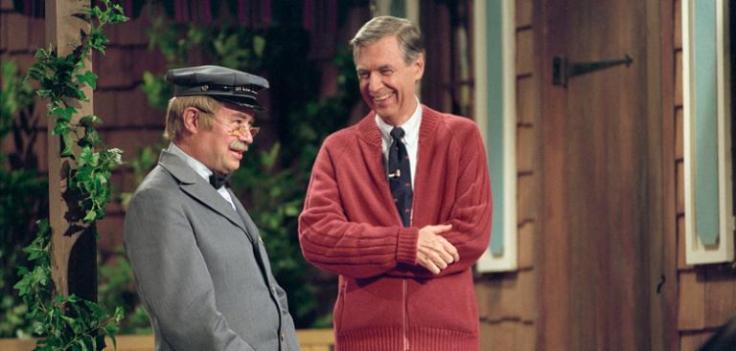
rogers2David Newell (left) and Fred Rogers (right) from the show Mr. Rogers Neighborhood in the film, WON’T YOU BE MY NEIGHBOR?, a Focus Features release. Credit: Lynn Johnson
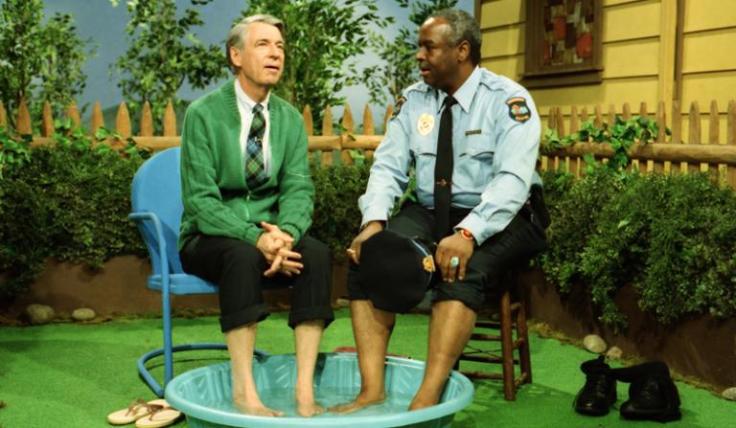
He was quiet. “For Fred, silence was his delight,” we’re told in Neighbor. We’re treated to a montage of some of the many times that he stopped talking and just let his audience … listen.

Most folks would call that “dead air,” back then as they would now. Today, to sit in silence is practically a cultural sin. We bring our phones and devices of distraction with us wherever we go, even into the toilet stall. I do, too. It’s like we can’t stand to be alone with ourselves. To grow quiet. To think. Rogers reminds us that when we lose silence, we lose much more. We lose, maybe, a bit of ourselves.

He listened. This might be one of the most remarkable things I was struck with watching Neighbor: How well he listened to those around him—no matter how young they were, no matter what they said. Children might tell him something funny. Or tragic. Or profound. He treated each missive as a gift—an almost sacred message, from one child of God to another.

I used to think of myself as a good listener. I’m not so sure anymore. I “talk” for a living, here and elsewhere. And sometimes, even when I’m listening even to the people most precious in my life, I feel my attention wander. I can feel my eyes darting, looking for the next distraction; search the conversation for another opportunity to let folks know what I think. How many times have I lost an opportunity to listen and learn? How many moments have I lost to create a greater connection? More broadly, how many of our societal ills and angsts could be treated and even healed through just … listening? I think we’d be surprised.

rogers 3Fred Rogers (left) with Francois Scarborough Clemmons (right) from his show Mr. Rogers Neighborhood in the film, WON’T YOU BE MY NEIGHBOR?, a Focus Features release. Credit: John Beale
He was gentle, but strong. In Neighbor, we see scenes aplenty when Rogers’ famous gentleness was mocked and lampooned. And indeed, his ultra-sincere persona and curious, almost lyrical-sounding voice can foster a very Rogers-esque stereotype of a milquetoast man. Truth is, he was anything but. He stood for things and, once he found his footing, never wavered from them. He stared down congress. He fought for racial equality. The very first week Mister Rogers’ Neighborhood was on the air, according to Neighbor, Rogers tackled the Vietnam War.

Today, we see politicians and pundits bluster and blow like big, bad wolves—huffing and puffing, bellowing and retracting what they just bellowed. Rogers did Theodore Roosevelt one better: He spoke quietly, and instead of carrying a stick, he bore only his convictions. And so often, they were enough.

We all have inconsistencies to our characters, of course. We sin. We fail. We think or say or do things we should not. Allof us do. Even, I’m sure, Mister Rogers. But everything I’ve read about him—and what I see in Neighbor—suggests that Rogers was as true to, and as honest with, himself, and thus to his audience, as anyone can be. He didn’t just pretend to listen: He listened. He didn’t just pretend to care: He cared. Tom Junod’s 1998 Esquire profile of Rogers illustrates that really well, and it might be one of the best profiles I’ve ever read. (caution, though. It can be profane at times.)

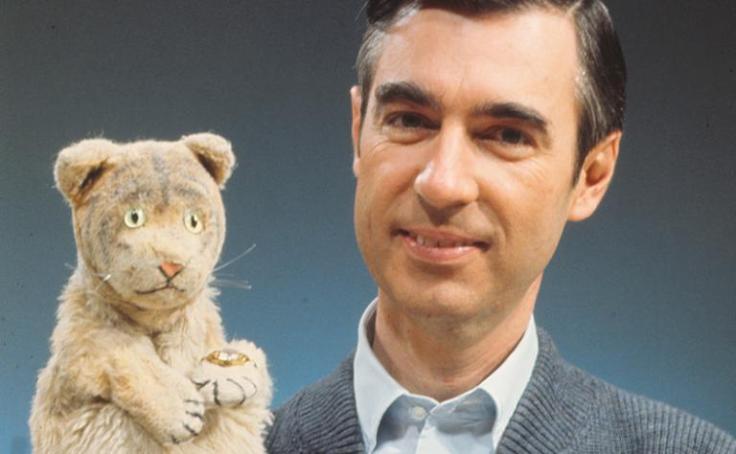
rogers 4.jpgFred Rogers with Daniel Tiger from his show Mr. Rogers Neighborhood in the film, WON’T YOU BE MY NEIGHBOR?, a Focus Features release. Credit: The Fred Rogers Company
He was vulnerable (in a way). Neighbor makes the case that Mr. Rogers’ puppet alter-ego was the watch-wearing Daniel Striped Tiger—sweet, shy and deeply vulnerable. Rogers admits in the movie that it’s far easier to let Daniel express his fears than he, as a grown man, to admit to them. But he, unlike most of us, still admits to them. And through Daniel, he gave the children he spoke to permission to express their own fears and doubts.

Funny that, in our social media age where we all share so much of ourselves, rarely do we share our vulnerability. We post our smiling vacation pictures and brag about our kids and express our deep political convictions in sometimes strident, shrill terms. But I think that often it’s our vulnerabilities, not our strengths, that make people gravitate toward us and allow them to trust us. I think that that’s part of what Paul meant in 2 Corinthians 12, when he told us that God’s power is made perfect in weakness. Rogers’ knew that, too. Our weaknesses open the door to fellowship. And that’s where strength is found.

He was devout. Rogers was an ordained minister, and throughout Neighbor we hear how Mister Rogers’ Neighborhood was his pulpit. He preached from his fake television house and told his young viewers that they were loved just as they were—but they still needed to learn and grow, too. And that brings us to, perhaps, Rogers’ most powerful, enduring message.

He believed in us all. That feels like a strong statement, but I don’t think it’s a stretch. Rogers believed in us all. He believed that all of us—young and old—were worthy of love. We were lovable.

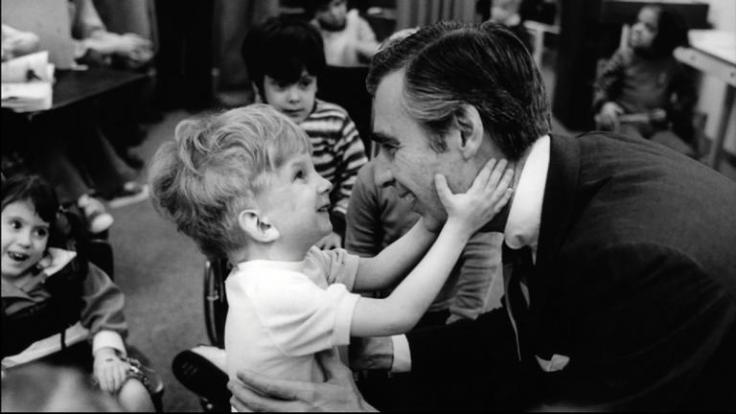
rogers 5.jpgFred Rogers meets with a disabled boy in the film WON’T YOU BE MY NEIGHBOR?, a Focus Features release. Credit : Jim Judkis


trolley

paul ansey.jpgAbout Paul Asay

Paul Asay is an author, journalist and entertainment critic who now serves as a senior associate editor for the popular Christian entertainment review site Plugged In (pluggedin.com). He has been published in a variety of other secular and Christian publications, including The Washington Post, The Gazette in Colorado Springs, YouthWorker Journal and Beliefnet.com. He has a love of old movies, a disturbing affinity for bad ones and an appreciation for all things geek.


Stop Being a Slave, Period.


(My Note:

I must say – when people say “unplug from tech” – we usually think of our entertainment devices: phones, televisions, etc. In my own life – it’s more than that.

I got rid of my clothes dryer last year because 1. it eats electricity like a fiend and I am budget conscious but also 2. because hanging clothes out to dry – relaxes me. It’s good for my mental health and stress levels.

The same with the dishwasher. I hand wash my dishes. It keeps my fingernails clean without my even having to try, and it also is relaxing, not to mention the metaphysical cleansing that happens with interaction with water. I think it’s way more cost effective than a dishwasher as well although I haven’t researched and proven that. It’s at least not using as much electricity, I am assuming that much. I do use the dishwasher – to DRY my dishes in. It keeps them off the counter space while they are drying.

Some of our “devices that are supposedly invented to ease our workload and give us convenience – in my opinion only speed our lives up and stress us out. They just give us the opportunity to do more work faster. And I don’t think that’s always a good thing. Then we take anti-depressants and drink alcohol to cope with the heightened speed and pace of our lives, and that is for our best, how? 

Just my opinion, but just because others say something is awesome and for our best – doesn’t mean it actually IS. Judge these things by your own standards, not society’s or commercial manufacturers, who have their own agendas in mind.

And now for the featured article lol:)

* * *

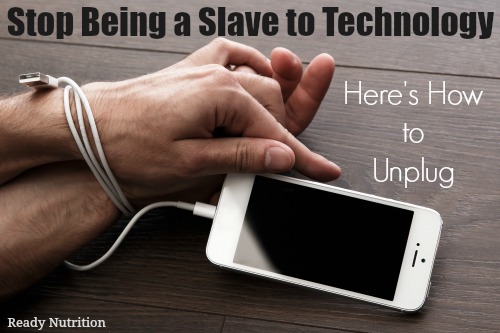
“Stop Being a Slave to Technology: Here’s How to Unplug”

by Joshua Krause

taken from www.readynutrution.com

If you could pluck any of your ancestors from any period of time in history, and send them to the world we live in now, they would be in for quite a shock. All of the technology that we have at our disposal would seem like magic to them. The diseases we can cure and prevent, the speed with which we can communicate with anyone around the world, the devastating weapons we use to defend ourselves with, and the machines we use to travel from place to place, would all leave them in awe.

They’d have to pick their jaws up from off the floor after they see what kinds of energy we use, and I’m not even talking about nuclear power. For people who relied on firewood for most of their energy needs, the cost and energy density of crude oil would blow their minds. I’m sure that seeing the accessibility of food in our society would cause a similar reaction in their minds. The idea that some people in the West only need to work a few hours a week to cover their food and energy costs, would leave your ancestors shaking.

And then they would meet us. The residents of this magical high-tech world.

They would see people who spend more time staring and laughing at their ghostly screens, than they spend interacting with other human beings. They would meet us, a generation of people who are terrified of the sun, and who can’t step outside without slathering themselves in odorous creams (or who barely spend any time outside at all). They would be introduced to people who can’t find their way home or solve any practical problem without first consulting the computers in their pockets. They would come face to face with a society that is willing to sacrifice privacy for high-tech convenience.

They would see a society full of people who are completely out of touch with nature, and completely helpless without all of their gadgets. And more importantly, they would discover how incredibly stressed and unhappy many of us are, despite the wonders at our disposal.

Truly, we are slaves to technology. Here’s what you should do if you want to break free, and get back in touch with your humanity.

Stop Multitasking

Multitasking is the bane of the modern world. We clean the house with the TV on in the background, we text on our phones while we eat dinner, and we talk on those same phones while we drive. People in the modern world are obsessed with cramming as many tasks in their day as they can, and they pride themselves on their ability to multitask. And even though most of us like to believe that we’re getting a lot done and that we’re really good at multitasking, in reality we all really suck at it.

Every scientific experiment that has tested people on their ability to multitask, has shown that it’s not an ability any of us have. Anytime we try to tackle more than one task at a time, we perform across the board. Unfortunately, the gadgets we own have made it incredibly easy for us to get distracted. We use our gadgets as a crutch and an excuse for when we don’t want to do the task at hand. So stay focused and do one thing at a time. You’ll do a better job, you’ll learn more, and you’ll enjoy yourself more.

Get Back in Touch With Nature

Despite how far civilization has advanced over the years, human beings still have pretty much the same brains and bodies that we had when we were hunter gatherers. In a sense, we are an anachronism. We live in this sophisticated, high-tech wonder world filled with 9-5 jobs, cars, phone bills, taxes, and gadgets, but we’re still the same people who used to spend the majority of their days in nature.

At heart, the outdoors is where we really feel comfortable, yet we live in a time where most of us, especially our children, spend so very little time there. Our brains were never designed for the task of staring at screens for 11+ hours a day, and we’ll never be truly happy if we don’t set the phone down and spend some time outside. We evolved in the outdoors. It’s where we belong. If we don’t set aside time to be away from the hum our gadgets, and to enjoy nature, we’ll never really feel fulfilled or satisfied. It might even make us a little crazy.

Try to Remember How You Killed Time Before The Internet

If you’re old enough to remember what life was like before the proliferation of the internet and smartphones, or if you’re young but you remember what life was like before your parents gave you access to those technologies, then you’re in luck. You actually have some sense of how normal human beings are supposed to behave when they don’t have anything important to do.

Do you remember what you used to do when you weren’t working, doing chores, or studying? Did you doodle or write? Did you play the guitar? Did you tinker with stuff lying around the house? Did you go for a walk around the neighborhood? Those are the sorts of things that people used to do when they didn’t have anything important on their plates.

These days we feel compelled to fill every waking moment with electronic entertainment. We act like boredom is a crime, and the only way to stay out of jail is to check our email and watch another episode of whatever is on Netflix. We have to keep our brains in a constant state of hyper-stimulation. We fear quiet, contemplative activities. If you really want to unplug from technology for a while, then you have to teach yourself to not reach for digital entertainment every time you find yourself with an empty moment. You have to kill that knee jerk response, and learn how to enjoy the things you do, not the things you watch other people do.

Quit Using Gadgets to Solve All your Problems

Undoubtedly, the internet is one of the most useful things that humanity has ever invented. Having that vast library of information at our fingertips is a godsend whenever we have a problem that needs solving. It’s provided a voice for countless ideas and people who would never have had a voice in the past. Unfortunately, it’s also making us stupid.

Whenever we have a problem, we’re faced with two solutions. Figure it out ourselves and learn a thing or two along the way, or if this problem is out of our depth, we enlist the help of a friend or we hire a guy to fix it. If the problem arises again in the future, we know who to call. We all have a ‘guy’ that we refer to when a car or a computer needs fixing.

We also treat the internet as ‘that guy.’ We refer to it anytime we need to fix something, or find directions, or remember an obscure fact. Every time we do that, our ability to remember and our ability to learn, dies a little. We know that if any given problem shows up again, we can just look it up. Our brains don’t bother to retain knowledge when we know that it can easily be recalled for us at the click of a button.

In the future, always try to do it yourself first before you ‘look it up.’ Try to remember a phone number before you look for it in your phone. Try to remember that witty quote before you search for it on the internet. Take a shot at finding your way home before you refer to your GPS. Your brain is like a muscle, and if you never bother to use it, you will lose it.

Do Nothing At All

I dare you. No, I double dog dare you, to do nothing at all. Do you even remember the last time you just sat alone in silence for a while? Have you stopped to consider how crazy it is that most people can no longer stand to be alone with their own thoughts? That’s not an exaggeration. The inability to withstand silence is a sign that you’re a slave to technology.

Scientists have conducted experiments where they place people in a room with blank walls, by themselves for 15 minutes, and tell them to just sit and enjoy their own thoughts. A third of the participants admitted to cheating and checking their phones. Most of them admitted that it was an unpleasant experience. Then they introduced a device that would give these participants a voluntary electric shock. Two thirds of the men and a quarter of the women in this study chose to shock themselves out of pure boredom. Many of us would prefer physical pain over doing nothing at all. That’s freaking sad.

If you really want to stop being a slave to technology, then every once in a while you should take time out of your day to do nothing at all. You don’t have to fill every moment of your waking life with vapid entertainment. Meditate, or stare at a wall, or quietly think about your future. It’s a normal, healthy part of being human, and our technology has robbed us of our ability to quietly be ourselves. So take back the reins, unplug yourself for a while, and enjoy being human again.

Joshua Krause was born and raised in the Bay Area. He is a writer and researcher focused on principles of self-sufficiency and liberty at Ready Nutrition. You can follow Joshua’s work at our Facebook page or on his personal Twitter.

Joshua’s website is Strange Danger

This information has been made available by Ready Nutrition

Originally published April 18th, 2016
* * *

3 Days Quote Challenge – Day 3

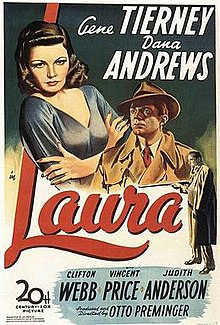
From the movie Laura. Great movie!                      220px-Laura23234

Thank you again, SyncWithDeep !!!!!!!!!!!!! For giving me this awesome fun game to play with you guys!

My quote:

The character of Waldo Lydecker at one point says:

“Let’s not be psychiatric.” 

And I just got such a kick out of it. I added it to my facebook favorite quotes along with my original Yeats quote and my Catherine Aird quote that you can find on my front menus of both my blogs, Kaleidoscope and Spinsta.

I love this quote because I am learning every day to integrate, heal, balance, live with, PTSD which causes in turn, some issues with depression and anxiety. This quote cracks me up lol.

I’m nominating these last three bloggers to carry on the Quotage:

Ricardo Sexton , O at the Edges, and the resident hottie, Texas.

Here are the rules:

  1. Thank the person who nominated you.

(you may mail chocolate to…..)

  1. Post a quote for three consecutive days (1 quote for each day).


  1. Share why this quote appeals so much to you.


  1. Nominate 3 different bloggers for each day.

Up ↑