Just so you all know, I’m going to slowly be shifting this blog towards more of a Tarot focus where I can explore my personal and professional journey with it, share it with others, and post readings for the Week, or Month, or whatever to help guide whoever wants it. I’m going to convert this blog because its address already matches my Tarot business name. My other one does not.

If Tarot isn’t your thing, I will not be offended if you would prefer to unsubscribe. At DaSpinstaLife I will still be posting anything I find interesting as I have done here, and you are welcome to subscribe to it instead if you wish. That blog has an MidLifie theme but since my midlife is still juvenile as fuck, there’s still plenty to see lol!!!!!


Marital Rape

Sunshiny SA, Kavitha's avatarSunshiny SA Site

survivornotavictim.comImage courtesy of survivornotavictim.com

How would you conjure the image of rape? Being pulled into some dark place, held against your will and forced upon, used and discarded by some stranger?

Except here, you are being violated in your home, forced and used by the husband who promised to love, honour and cherish you.
Sadly, this is marital rape.

Marital rape is considered a form of domestic violence and sexual abuse. Although, historically, sexual intercourse within marriage was regarded as a right of spouses, engaging in the act without the spouse’s consent is now widely recognized by law and society as a wrong and as a crime.
Source : https://en.wikipedia.org/wiki/Marital_rape

Marital rape with violence and threats is real, illegal and not defined by colour. This should not be allowed to continue. Mind-sets need to change. A wife is not a chattel, but a life partner and often, the mother of…

View original post 5,597 more words

Leadership

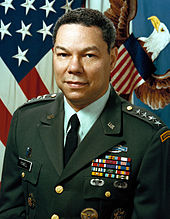
“Being in charge means making decisions, no matter how unpleasant. If it’s broke, fix it . . . you cannot let the mission suffer, or make the majority pay to spare the feelings of an individual.”

-Colin L. Powell, My American Journey 

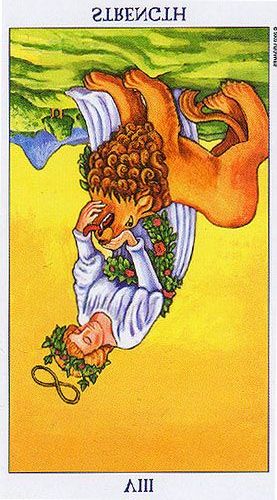
Biddy Card of the Week, Strength Reversed

“I’ve been taking these stutter steps towards my future for a long time now, unsure if I can do it, unsure if my difficulties are just growing pains or permanent disability. I need to take a lot of breaks to rest and re-group, but even if I have to hop instead of fly most of the time, I keep going. Just like the little bird.” 

– The Little Bird, by Rachel Mankowitz

* * * *

Biddy Tarot’s Card of the Week is Strength, reversed.

Biddy Tarot says that:

“This week, you may be feeling exhausted and in need of an energy boost. Remember, all your energy reserves and strength come from within. Take some time out this week to pause and reflect, and gather up your energy. Even though you may be lacking in strength, vitality and energy, it doesn’t mean you have to be completely incapacitated this week. Instead, go within to access your energy reserves and restore your inner strength.

You may also find that your inner strength and confidence is compromised this week. You may be doubting yourself and your ability to move through any challenges that have come your way. This is your opportunity to go deep within, and reconnect with your inner source of power and strength. You may have relied on others to provide this to you in the past, but the important lesson here is that only YOU can do this and you will be at your strongest when you discover how to find that part of you that is fierce and powerful!

Ask the Tarot: How can I restore my inner strength?”

(Esselmont)

* * *


* * *

I am indeed “feeling exhausted,” “lacking in strength, vitality and energy,” and “doubting” myself and my “ability to move through … challenges” this week (Esselmont). So this card is a nice reminder and encouragement for me. 

I also had never thought of viewing “feeling exhausted” as an Opportunity – an “opportunity to reconnect with” my “inner source of power and strength (Esselmont).”

Literally – like – “Yay, this week I get to really challenge myself”, or “Awesome, I get to utilize my inner reserves!”

So that’s an interesting way to view it instead of just “Oh my god, I”m so exhausted.” I’m going to give that a go, I think.

My exhaustion is temporary anyway, and I know it. Started work at a retail store last week after 15 years of cushy office work and my body is coming up the physical labor remembrance curve hard and fast, taking no prisoners. So positive outlooks have been getting washed away by “Oh my god I just need to sleep 16 hours to rejuvenate.”  I’m feeling good tonight, but that’s only because I slept all last night and half of today, and that seems to be what it takes to recover from working.

Going to come back to this and re read after my next shifts so I can remember that its a blessing to have the opportunity to give my inner reserves of strength a trial run here and there.

Hope it helps some of you as well!

And you can click here if you want to read up on Biddy’s official Strength card attributes, both Upright and Reversed, in more detail.


Works Cited

Esselmont, Brigit. “Strength Reversed.” Received by Michelle Sebly, 6 Aug 2018.

Organization the Continuum
This is the Shadow side of Organization. The Dark Side.                                                                                                                                          This is where it ends, self destructs, is reborn, and begins again.


And then my Assistant rearranges it:

ORGNAIZATION CONTIUUM . PART 2.jpg

My Assistant:

0703180810

She’s had a hard day at work.

Seven Reasons Why . . .

. . . We Need Mister Rogers More Than Ever

JUNE 6, 2018 BY PAUL ASAY, of Watching God

Photo: Fred Rogers on the set of his show Mr. Rogers Neighborhood from the film, WON’T YOU BE MY NEIGHBOR?, a Focus Features release. Credit: Jim Judkis

trolley.jpg

On Feb. 2, 1968—Groundhog Day—Simon & Garfunkel recorded the final version of their classic song “Mrs. Robinson” for their album Bookends. It includes one of the most poignant lines in all of pop music:

Where have you gone, Joe DiMaggio? Our nation turns its lonely eyes to you.

“I thought of him as an American hero and that genuine heroes were in short supply,” Paul Simon later told The New York Times. And indeed, in early 1968, they were. The country was mired in the Vietnam War. Protests raged at home. The country had never felt so divided, so angry. After the heroics of World War II and the unbridled American self-confidence of the 1950s, the United States must’ve felt like a stick bent to its breaking point, ready to splinter.

The country needed a hero.

On Feb. 19, 1968, just 17 days after Simon & Garfunkel put Mrs. Robinson in Bookends, it got one.

Most folks didn’t know it yet, of course. Mister Rogers’ Neighborhood, featuring a rather un-telegenic, soft-spoken minister as its host, director, singer, writer and puppeteer, was meant for kids too young to tie their shoes, much less write think-pieces for The New Yorker. But as Focus Features’ new, wonderful documentary Won’t You Be My Neighbor (out in theaters beginning this weekend) illustrates, he was a good hero for those turbulent times. And, I think, the sort of hero we need more than ever.

Fred Rogers wasn’t a television novice when he launched Mister Rogers’ Neighborhood on NET (the forerunner to PBS) in 1968. He’d worked on a show called The Children’s Corner for Pittsburgh’s WQED years before, introducing Daniel Tiger when (according to the movie) one of the live show’s ancient film clips broke.

But if Daniel’s introduction to the world of television was a spontaneous thing, Mister Rogers’ Neighborhood was anything but. As Neighbor unpacks for us, Rogers carefully thought through every word and lyric, almost every moment, crafting a show that would never talk down to its young viewers but wrap an arm around them and talk to them. Rogers called the space between his cameras and his viewers’ televisions “holy ground,” and indeed something sacrosanct took place there.

When you contrast what Mister Rogers did back then with our own frenetic entertainment culture—heck, with our entire national climate—it’s striking to see the difference, and feel just what we’re lacking. Consider:
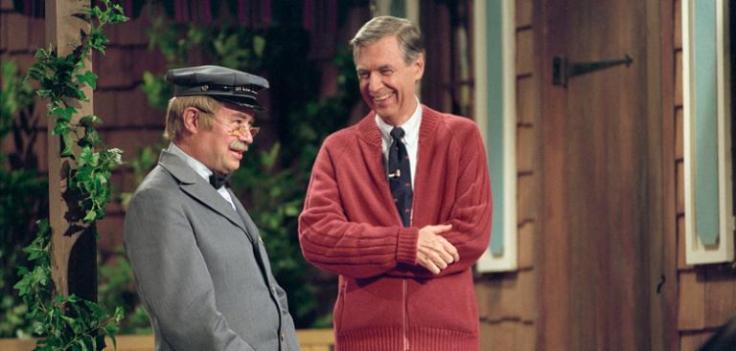
rogers2David Newell (left) and Fred Rogers (right) from the show Mr. Rogers Neighborhood in the film, WON’T YOU BE MY NEIGHBOR?, a Focus Features release. Credit: Lynn Johnson

He was quiet. “For Fred, silence was his delight,” we’re told in Neighbor. We’re treated to a montage of some of the many times that he stopped talking and just let his audience … listen.

Most folks would call that “dead air,” back then as they would now. Today, to sit in silence is practically a cultural sin. We bring our phones and devices of distraction with us wherever we go, even into the toilet stall. I do, too. It’s like we can’t stand to be alone with ourselves. To grow quiet. To think. Rogers reminds us that when we lose silence, we lose much more. We lose, maybe, a bit of ourselves.

He listened. This might be one of the most remarkable things I was struck with watching Neighbor: How well he listened to those around him—no matter how young they were, no matter what they said. Children might tell him something funny. Or tragic. Or profound. He treated each missive as a gift—an almost sacred message, from one child of God to another.

I used to think of myself as a good listener. I’m not so sure anymore. I “talk” for a living, here and elsewhere. And sometimes, even when I’m listening even to the people most precious in my life, I feel my attention wander. I can feel my eyes darting, looking for the next distraction; search the conversation for another opportunity to let folks know what I think. How many times have I lost an opportunity to listen and learn? How many moments have I lost to create a greater connection? More broadly, how many of our societal ills and angsts could be treated and even healed through just … listening? I think we’d be surprised.
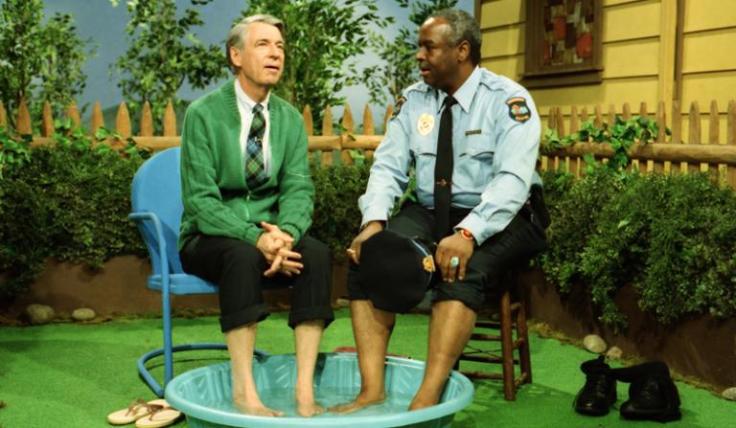
rogers 3Fred Rogers (left) with Francois Scarborough Clemmons (right) from his show Mr. Rogers Neighborhood in the film, WON’T YOU BE MY NEIGHBOR?, a Focus Features release. Credit: John Beale

He was gentle, but strong. In Neighbor, we see scenes aplenty when Rogers’ famous gentleness was mocked and lampooned. And indeed, his ultra-sincere persona and curious, almost lyrical-sounding voice can foster a very Rogers-esque stereotype of a milquetoast man. Truth is, he was anything but. He stood for things and, once he found his footing, never wavered from them. He stared down congress. He fought for racial equality. The very first week Mister Rogers’ Neighborhood was on the air, according to Neighbor, Rogers tackled the Vietnam War.

Today, we see politicians and pundits bluster and blow like big, bad wolves—huffing and puffing, bellowing and retracting what they just bellowed. Rogers did Theodore Roosevelt one better: He spoke quietly, and instead of carrying a stick, he bore only his convictions. And so often, they were enough.

We all have inconsistencies to our characters, of course. We sin. We fail. We think or say or do things we should not. Allof us do. Even, I’m sure, Mister Rogers. But everything I’ve read about him—and what I see in Neighbor—suggests that Rogers was as true to, and as honest with, himself, and thus to his audience, as anyone can be. He didn’t just pretend to listen: He listened. He didn’t just pretend to care: He cared. Tom Junod’s 1998 Esquire profile of Rogers illustrates that really well, and it might be one of the best profiles I’ve ever read. (caution, though. It can be profane at times.)

rogers 4.jpgFred Rogers with Daniel Tiger from his show Mr. Rogers Neighborhood in the film, WON’T YOU BE MY NEIGHBOR?, a Focus Features release. Credit: The Fred Rogers Company

He was vulnerable (in a way). Neighbor makes the case that Mr. Rogers’ puppet alter-ego was the watch-wearing Daniel Striped Tiger—sweet, shy and deeply vulnerable. Rogers admits in the movie that it’s far easier to let Daniel express his fears than he, as a grown man, to admit to them. But he, unlike most of us, still admits to them. And through Daniel, he gave the children he spoke to permission to express their own fears and doubts.

Funny that, in our social media age where we all share so much of ourselves, rarely do we share our vulnerability. We post our smiling vacation pictures and brag about our kids and express our deep political convictions in sometimes strident, shrill terms. But I think that often it’s our vulnerabilities, not our strengths, that make people gravitate toward us and allow them to trust us. I think that that’s part of what Paul meant in 2 Corinthians 12, when he told us that God’s power is made perfect in weakness. Rogers’ knew that, too. Our weaknesses open the door to fellowship. And that’s where strength is found.

He was devout. Rogers was an ordained minister, and throughout Neighbor we hear how Mister Rogers’ Neighborhood was his pulpit. He preached from his fake television house and told his young viewers that they were loved just as they were—but they still needed to learn and grow, too. And that brings us to, perhaps, Rogers’ most powerful, enduring message.

He believed in us all. That feels like a strong statement, but I don’t think it’s a stretch. Rogers believed in us all. He believed that all of us—young and old—were worthy of love. We were lovable.
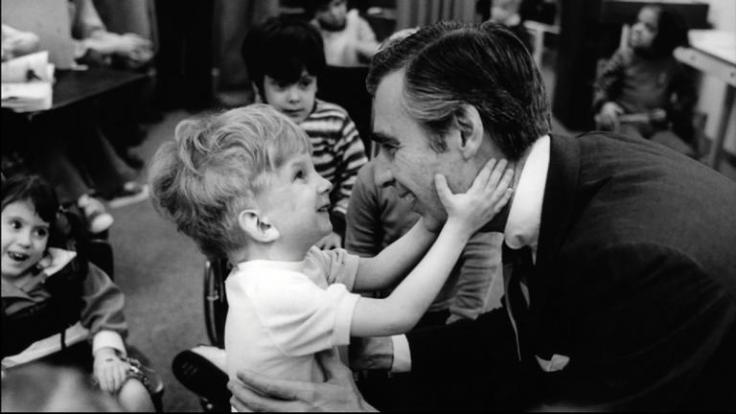
rogers 5.jpgFred Rogers meets with a disabled boy in the film WON’T YOU BE MY NEIGHBOR?, a Focus Features release. Credit : Jim Judkis


trolley

paul ansey.jpgAbout Paul Asay

Paul Asay is an author, journalist and entertainment critic who now serves as a senior associate editor for the popular Christian entertainment review site Plugged In (pluggedin.com). He has been published in a variety of other secular and Christian publications, including The Washington Post, The Gazette in Colorado Springs, YouthWorker Journal and Beliefnet.com. He has a love of old movies, a disturbing affinity for bad ones and an appreciation for all things geek.

 

A Summer Evening’s Meditation

(entire poem)

By Anna Laetitia Barbauld

AA003102

“Anna Barbauld’s ‘A Summer Evening’s Meditation’ is a late contribution to the cosmic voyage genre of poetry, which had enjoyed popularity during the first half of the eighteenth century. Studying the poem in the context of this literature calls attention to what is innovative about Barbauld’s text: most notably, its allusion to Eve in introducing gender struggles to a genre that had been almost exclusively the province of male authors. In defying the cultural boundaries that had constrained the imaginations of female predecessors, Barbauld provides us with the first instance in English literature of a woman exploring modern deep space.”

– from: “Anna Letitia Barbauld’s ‘A Summer Evening’s Meditation’ and the Cosmic Voyage since Paradise Lost” by Rob BrowningFirst published: 20 August 2015, https://doi.org/10.1111/1754-0208.12339

Books-3.jpg

A Summer Evening’s Meditation

‘TIS past! The sultry tyrant of the south
Has spent his short-liv’d rage; more grateful hours
Move silent on; the skies no more repel
The dazzled sight, but with mild maiden beams
Of temper’d light, invite the cherish’d eye
To wander o’er their sphere; where hung aloft
DIAN’s bright crescent, like a silver bow
New strung in heaven, lifts high its beamy horns

Impatient for the night, and seems to push
Her brother down the sky. Fair VENUS shines
Even in the eye of day; with sweetest beam
Propitious shines, and shakes a trembling flood
Of soften’d radiance from her dewy locks.
The shadows spread apace; while meeken’d Eve
Her cheek yet warm with blushes, slow retires
Thro’ the Hesperian gardens of the west,
And shuts the gates of day. ‘Tis now the hour
When Contemplation, from her sunless haunts,
The cool damp grotto, or the lonely depth
Of unpierc’d woods, where wrapt in solid shade
She mused away the gaudy hours of noon,
And fed on thoughts unripen’d by the sun,
Moves forward; and with radiant finger points
To yon blue concave swell’d by breath divine,
Where, one by one, the living eyes of heaven
Awake, quick kindling o’er the face of ether

One boundless blaze; ten thousand trembling fires,
And dancing lustres, where th’ unsteady eye
Restless, and dazzled wanders unconfin’d
O’er all this field of glories: spacious field!
And worthy of the master: he, whose hand
With hieroglyphics older than the Nile,
Inscrib’d the mystic tablet; hung on high
To public gaze, and said, adore, O man!
The finger of thy GOD. From what pure wells
Of milky light, what soft o’erflowing urn,
Are all these lamps so fill’d? these friendly lamps,
For ever streaming o’er the azure deep
To point our path, and light us to our home.
How soft they slide along their lucid spheres!
And silent as the foot of time, fulfil
Their destin’d courses: Nature’s self is hush’d,
And, but a scatter’d leaf, which rustles thro’
The thick-wove foliage, not a sound is heard

To break the midnight air; tho’ the rais’d ear,
Intensely listening, drinks in every breath.
How deep the silence, yet how loud the praise!
But are they silent all? or is there not
A tongue in every star that talks with man,
And wooes him to be wise; nor wooes in vain:
This dead of midnight is the noon of thought,
And wisdom mounts her zenith with the stars.
At this still hour the self-collected soul
Turns inward, and beholds a stranger there
Of high descent, and more than mortal rank;
An embryo GOD; a spark of fire divine,
Which must burn on for ages, when the sun,
(Fair transitory creature of a day!)
Has clos’d his golden eye, and wrapt in shades
Forgets his wonted journey thro’ the east.

Ye citadels of light, and seats of GODS!
Perhaps my future home, from whence the soul

Revolving periods past, may oft look back
With recollected tenderness, on all
The various busy scenes she left below,
Its deep laid projects and its strange events,
As on some fond and doating tale that sooth’d
Her infant hours; O be it lawful now
To tread the hallow’d circles of your courts,
And with mute wonder and delighted awe
Approach your burning confines. Seiz’d in thought
On fancy’s wild and roving wing I sail,
From the green borders of the peopled earth,
And the pale moon, her duteous fair attendant;
From solitary Mars; from the vast orb
Of Jupiter, whose huge gigantic bulk
Dances in ether like the lightest leaf;
To the dim verge, the suburbs of the system,
Where chearless Saturn ‘midst her watry moons
Girt with a lucid zone, majestic sits

In gloomy grandeur; like an exil’d queen
Amongst her weeping handmaids: fearless thence
I launch into the trackless deeps of space,
Where, burning round, ten thousand suns appear,
Of elder beam; which ask no leave to shine
Of our terrestrial star, nor borrow light
From the proud regent of our scanty day;
Sons of the morning, first born of creation,
And only less than him who marks their track,
And guides their fiery wheels. Here must I stop,
Or is there aught beyond? What hand unseen
Impels me onward thro’ the glowing orbs
Of inhabitable nature; far remote,
To the dread confines of eternal night,
To solitudes of vast unpeopled space,
The desarts of creation, wide and wild;
Where embryo systems and unkindled suns
Sleep in the womb of chaos; fancy droops,

And thought astonish’d stops her bold career.
But oh thou mighty mind! whose powerful word
Said, thus let all things be, and thus they were,
Where shall I seek thy presence? how unblam’d
Invoke thy dread perfection?
Have the broad eye-lids of the morn beheld thee?
Or does the beamy shoulder of Orion
Support thy throne? O look with pity down
On erring guilty man; not in thy names
Of terrour clad; not with those thunders arm’d
That conscious Sinai felt, when fear appall’d
The scatter’d tribes; thou hast a gentler voice,
That whispers comfort to the swelling heart,
Abash’d, yet longing to behold her Maker.

But now my soul unus’d tostretch her powers
In flight so daring, drops her weary wing,
And seeks again the known accustom’d spot,

Drest up with sun, and shade, and lawns, and streams,
A mansion fair and spacious for its guest,
And full replete with wonders. Let me here
Content and grateful, wait th’ appointed time
And ripen for the skies: the hour will come
When all these splendours bursting on my sight
Shall stand unveil’d, and to my ravished sense
Unlock the glories of the world unknown.

 https://www.poemhunter.com/poem/a-summer-evening-s-meditation-2/

SuDic

Inspired

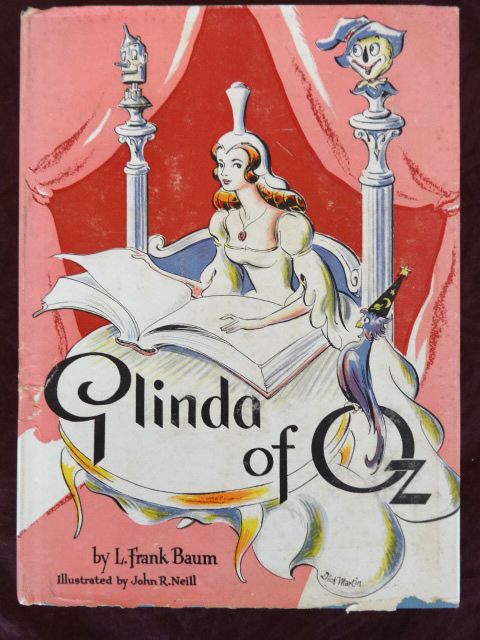
by Frank Baum’s “Glinda of Oz,”

I have decided to inform the children

they may call me

“Supreme Dictator”

from now on.


***UPDATE***

I told the 7 year old about preferring to be called Supreme Dictator. He said “Supreme Dictator?!!!! I’m not gonna call you that! I’m gonna call you MOMMY that’s what I”M gonna call you!” 

Up ↑