
Inspired by Yule: A Celebration of Light and Warmth by Dorothy Morrison
Morrison’s book says the Advent Wreath “initially came from the Lutherans,” which I found to be very cool be cause that is the first church I can remember attending, as well as that is the church that I was confirmed in.
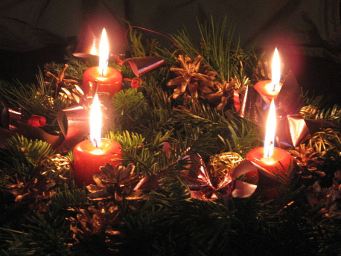
As she explains, the wreath is traditionally made of evergreen and has four candles arranged at each “side” of it. Four Sundays out from Christmas the church has someone light a candle, and one is lit each Sunday until Christmas occurs.
***
Something I did NOT know, and which was not in Morrison’s book (due to space considerations), was that the candle is supposed to burn all week long, “to welcome the Light of the world” (capitalization mine). I guess they can’t really do that now (and would they even have done it in the beginning?) due to safety issues, but that is a really nice tradition to think of. One source says that the very first Advent wreath had “twenty small red candles and four large white candles” in it (Richie). A Lutheran minister had made it for the kids to count down to Christmas. The little red candles were lit on the weekdays while the big white ones were the Sunday candles. But I still can’t imagine they would just leave them burning the entire day.
In present time the German colors are usually red for the four big candles, and sometimes a fifth white one in the middle to represent the birth of Christ, though colors sometimes vary according to different traditions. North American Lutherans use violets and blues and whites.
This is supposed to be a traditional German advent wreath:
And something else that Morrison doesn’t go into detail about is the symbolism of the individual candles themselves, which I REALLY think is cool:
- The first candle symbolizes hope and is called the “Prophet’s Candle.” The prophets of the Old Testament, especially Isaiah, waited in hope for the Messiah’s arrival.
- The second candle represents faith and is called “Bethlehem’s Candle.” Micah had foretold that the Messiah would be born in Bethlehem, which is also the birthplace of King David.
- The third candle symbolizes joy and is called the “Shepherd’s Candle.” To the shepherd’s great joy, the angels announced that Jesus came for humble, unimportant people like them, too. In liturgy, the color rose signifies joy.
- The fourth candle represents peace and is called the “Angel’s Candle.” The angels announced that Jesus came to bring peace–He came to bring people close to God and to each other again.
- The (optional) fifth candle represents light and purity and is called “Christ’s candle.” It is placed in the middle and is lit on Christmas Day.
(Richie)
Right from the Source’s Mouth, St. Matthews Lutheran Church, is an explanation of the Advent season itself as well as a much more poetic description of the candle meanings. Check it out if you get a chance.
When I was little, it was exciting as a child to see each additional candle get lit and then when all four were burning, we knew Christmas was near!
So, Thank You to the Lutheran branch of Christianity, for this awesome Christmas tradition!
Works Cited
Morrison, Dorothy. Yule: A Celebration of Light and Warmth. St. Paul, MN, Llewellyn
Publications, 2000.
Richie, Laura. “Advent Wreath & Candles: Understanding the Meaning, History &
Tradition. Crosswalk.com. 22 August 2018, https://www.crosswalk.com/special
coverage/christmas-and-advent/advent-wreath-candles-understanding-the
meaning-history-tradition.html, Accessed 17.12.2018.




 Fiery K. Tarot
Reblogged this on The Spinsta Life.
LikeLike